If you’ve ever stared at two collagen labels and thought, ‘Wait… aren’t these the same thing?’ you’re not alone.
That confusion is real. One bottle says hydrolyzed collagen. Another says collagen peptides. Both are framed as premium choices. Both sit in the same wellness aisle. And both can leave you wondering whether you’re being sold a meaningful difference or just a clever word swap.
Here’s the short version: hydrolyzed collagen and collagen peptides are usually used to describe the same kind of ingredient. The real question is not which phrase sounds better on the front of the tub. It’s what’s behind the label: source, processing, testing, purity, and whether the format actually fits your routine.
That last part matters more than people think. The best supplements for longevity are rarely the flashiest ones. They’re the ones you can take consistently, understand clearly, and trust without squinting at the ingredient panel like you’re decoding a tax form.
So what’s the difference, exactly?
In plain English, collagen is a structural protein found in the body. When manufacturers make a supplement, they usually break that large protein down into smaller pieces through a process called hydrolysis. Those smaller pieces are what most shoppers know as collagen peptides.
That means “hydrolyzed collagen” describes the process, while “collagen peptides” describes the end result. In supplement land, those terms are often used interchangeably. So if you were expecting a dramatic difference, the truth is a little less dramatic and a lot more useful: the label wording alone usually isn’t the thing that should decide your purchase.
What matters more is whether the product is clean, transparent, and actually worth adding to your daily stack.
The real supplement question is rarely ‘What sounds better?’ It’s ‘What can I verify, and what will I actually use every day?’
Why does this label confusion keep happening
Supplement brands know shoppers are trying to make smarter choices. They also know most people don’t want to spend 20 minutes researching peptide terminology between meetings. So the industry does what the industry always does: it turns a simple ingredient into a branding opportunity.
That’s why you’ll see products use one phrase on the front, another phrase in the fine print, and a third phrase in the marketing copy. The result is a lot of noise and not much clarity.
From a buyer’s perspective, the frustration is understandable. People want to know:
Are hydrolyzed collagen and collagen peptides actually different?
Is one better than the other for daily use?
What should I look for if I want a clean-label supplement?
How do I know I’m not just paying extra for packaging?
Those are the right questions. And they matter even more for people shopping for Miami FL biohacking supplements, Miami FL wellness supplements, or Miami FL vitamin supplements, where the market is full of premium branding and big promises. If you’re looking for the best supplements for longevity, the name on the label is only the starting point.
What actually matters more than the wording
If you want to evaluate collagen like a biohacker instead of a casual shopper, you need to think beyond the headline term. Here’s the checklist that actually helps.
1. The source
Collagen can come from different sources, and that matters. Marine, bovine, and other source types may fit different preferences, dietary needs, or routines. The important thing is not whether the brand uses a trendy phrase. It’s whether the source is disclosed clearly and honestly.
Full transparency should mean you know what you’re buying without needing to reverse-engineer the label.
2. The processing
Hydrolysis is what breaks collagen into smaller fragments. That’s the basic idea behind collagen peptides. But not all processing is created equal, and not every brand explains what it does in a way normal humans can understand.
If a company won’t explain how the ingredient is prepared, or keeps the description vague, that should make you pause. A premium product should be able to explain itself without hiding behind wellness fog.
3. The testing
This is the part shoppers often skip, then regret later. For clean-label supplements, you want proof that the product is what it says it is. Look for third-party tested products, clear quality standards, and a readily available COA, or certificate of analysis, when the brand provides one.
That doesn’t mean you should expect a lab report for fun. It means the company is willing to show its work. In a crowded supplement category, that matters.
4. The extra stuff you didn’t ask for
Some products are clean and simple. Others are padded with sweeteners, flavor systems, thickeners, fillers, binders, or unnecessary add-ons that make the formula look busier than it needs to be.
If you’re trying to build a high-purity routine, ask a basic question: what’s in here that doesn’t need to be?
The cleanest products tend to answer that question well. The messiest ones hope you don’t ask.
5. The format
This is where a lot of well-intentioned supplement routines fall apart. A powder can be high quality and still be annoying to use. Capsules can be clean and still end up forgotten in a drawer. Gummies can be easy and still come with sugar, flavoring, or a texture that people stop liking after a week.
For busy professionals, frequent travelers, and anyone chasing sustainable energy without friction, format is not a side issue. It’s part of effectiveness.
If you won’t use it consistently, it doesn’t matter how elegant the formula is.
Collagen peptides aren’t magic. Consistency is the point.
There’s a reason collagen sits in so many wellness routines: people want a simple way to support skin, joints, recovery, and overall vitality as part of a broader health strategy. But there’s also a reason some people buy collagen once and then never touch the jar again.
The problem usually isn’t just the ingredient. It’s the routine.
Maybe the powder is messy. Maybe the scoop disappears. Maybe the taste is fine for a week, then it becomes one more thing you don’t feel like doing at 7 a.m. Maybe you travel, work remotely, or move between home, office, gym, and airport like a human calendar. If the supplement isn’t convenient, adherence drops. Fast.
That’s why the cleanest ingredient in the world still needs a usable format. At EverLiv, we think about this all the time. Our focus is on oral strips with transmucosal delivery because the modern routine needs to be simple, portable, and realistic. No water. No binders. No pills to chase with a coffee you may or may not finish before your next call.
Different ingredients, same lesson: the best wellness system is the one that fits real life.
What a smart collagen label should tell you at a glance
If you’re reading a supplement label like a skeptic, here’s what you want to see before you buy:
Clear source disclosure so you know where the collagen comes from
Simple ingredient panels with no unnecessary fillers or binders
Third-party tested or similarly verified quality standards
COA access or a clear path to verify purity and potency
Transparent serving information so you understand the daily use pattern
A format you’ll stick with, whether that’s powder, capsules, or another delivery system
If a brand is serious about quality, it should make those answers easy to find. Not hidden. Not vague. Not buried under lifestyle language and stock-photo optimism.
Is one term better for absorption?
People often ask whether hydrolyzed collagen or collagen peptides are better for absorption. The honest answer: the terminology itself is not the main story. Because hydrolyzed collagen is already broken down into smaller fragments, the focus should be on how the ingredient is made, how the product is formulated, and whether the brand is actually transparent about quality.
In other words, don’t get hypnotized by a single word on the front of the bottle. Look at the whole product.
That’s also where a lot of blog content misses the point. Most articles stop at, “They’re basically the same.” Which is true, but incomplete. The better question is: if they’re functionally similar, why does one product cost twice as much and still hide behind vague language? Sometimes the answer is marketing. Sometimes it’s packaging. Sometimes it’s the use of cleaner inputs and better testing. Your job is to tell the difference.
What biohackers usually care about, and why they’re right to care
Biohacker-minded shoppers tend to be suspicious in a healthy way. They don’t just want a bottle that looks premium. They want evidence that the product deserves a place in a carefully built routine.
That usually means asking about:
Ingredient sourcing
Processing methods
Third-party testing
Label transparency
Convenience and adherence
That mindset is useful even if you’re not deep into the biohacking world. You don’t need to be measuring everything with spreadsheets to benefit from a cleaner system. You just need to care enough to avoid the supplement clutter trap.
And yes, that includes wondering whether a product is actually worth the money. Premium pricing is fine when the company can explain exactly what you’re paying for. It’s much less fine when the only difference is a shinier label.
If you already use protein, do you still need collagen?
This is another question people ask a lot, and it’s a fair one. Collagen is not the same thing as a general protein powder, and people often include it in a routine for different reasons. But whether it belongs in your stack depends on your goals, your current nutrition, and how much complexity you actually want.
From a practical standpoint, the smartest approach is to keep your routine clean and intentional. Don’t collect supplements like trophies. Build a 24-hour loop that supports how you live: what you take in the morning, what helps you stay steady through the day, and what supports relaxation and deep REM sleep at night.
That’s where the big lesson here applies beyond collagen. The supplement category is moving toward simpler formulas, clearer labels, and more convenient delivery. People want performance without clutter. Vitality without a drawer full of half-used containers. Clean energy without a crash. Calm focus without jitters. And, increasingly, they want all of that without pills, gummies, or water bottles that follow them everywhere.
The bottom line: choose the cleaner, clearer, easier option
So, hydrolyzed collagen vs collagen peptides: are they the same thing? Usually, yes. At least close enough that the label wording alone should not be the reason you choose one product over another.
What should decide it instead?
The source of the collagen
The transparency of the brand
The quality testing behind the product
Whether the formula avoids fillers and binder-heavy extras
Whether the format fits your actual life
If you want the most honest answer, it’s this: the best collagen supplement is the one you can trust and use consistently. Not the one with the most dramatic front label.
That’s the standard we believe more shoppers should use across the entire supplement aisle, whether you’re comparing collagen, looking at oral vitamin strips, or trying to simplify your daily stack with supplements that don't require water and have fewer moving parts. The future of wellness is not more clutter. It’s a better design.
What to do next
Before you buy your next collagen product, read the label like a skeptic. Check the source. Look for third-party testing. Look for a COA if the brand provides one. And ask yourself one honest question: Will I actually use this every day?
If your answer is no, the ingredient may be fine, but the format is wrong. If your answer is yes, you’re already making a smarter choice.
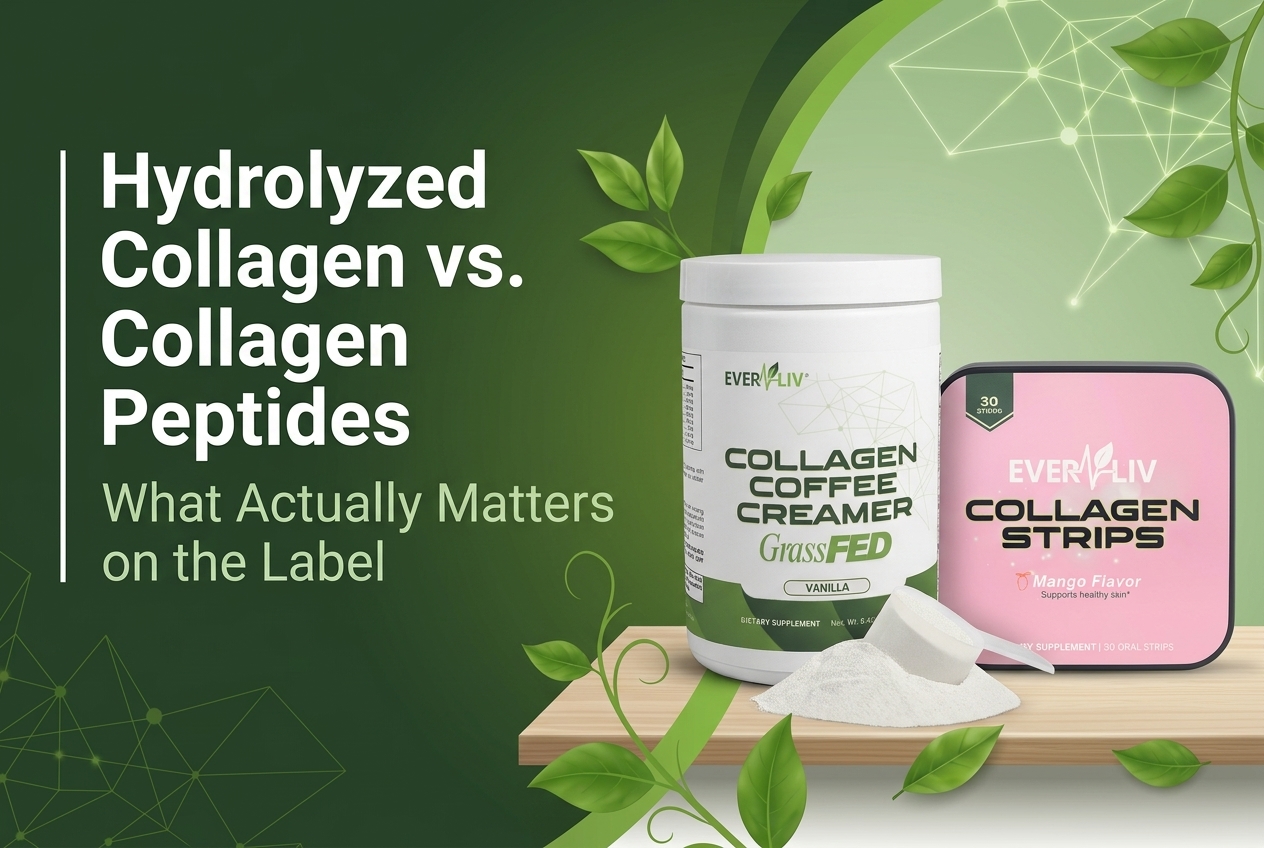
And if you’re building a cleaner routine overall, explore products that are designed for real-world consistency: portable, high-purity, science-backed, and simple enough to stick with. That’s the logic behind EverLiv’s Collagen oral strips and our approach to bio-optimization: less friction, more follow-through, and a routine that respects your time. Or try our specific collagen formulas for home or office use today. Feel better, live better with Everliv.